Mission Statement
“The City of Hutchinson’s Wastewater department shall strive to provide safe, affordable, quality service to our customers, protect and preserve the environment, while maintaining or exceeding all Federal and State regulations.”
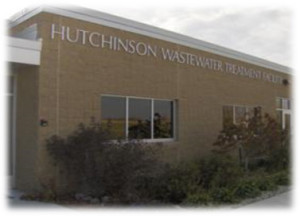
The Hutchinson Wastewater Facility was placed in service in 1988 and is classified as a ‘Class A’ facility.
The current wastewater treatment facility was originally constructed and put into service in 1988 at the Adams Street location. In 2008 a major expansion was completed to accommodate community growth and industrial expansion.
Designed to treat an average 3.67 million gallons per day (MGD) of wastewater, the facility will meet the wastewater treatment needs of the city through the year of 2028. There are 13 lift stations and over 75 miles of gravity sanitary sewer lines throughout Hutchinson. The wastewater treatment facility continually undergoes changes as new technologies and ever more stringent state and federal environmental regulations come into place. The treatment facility has several features, which allow it to meet Hutchinson’s specific needs for variable flows and operational flexibility. Biological and Membrane Bioreactor (MBR) processes are used to remove impurities from the wastewater and achieve a level of treatment well above that which is mandated by the Minnesota Pollution Control Agency (MPCA). As part of the most recent NPDES operating permit reissuance, the facility entered into a compliance schedule with the MPCA where measures will be taken to meet an ultra-low phosphorous discharge limit of 0.32 part per million (ppm) for the months of May through September by May of 2030.
The Facility has a staff of six people that include: Wastewater Manager, Senior Wastewater Operator, Laboratory Technician/WW Operator, Senior Maintenance Operator, Wastewater Maintenance Operator and a shared Public Works Relief Operator.
Contact Us
- Normal Hours of Operation: 7:00 am to 3:30 pm, Monday – Friday.
- Wastewater Treatment Facility Office Phone: (320) 234-4233
- Facility Fax: (320) 234-7485
- After Hours Emergency call (320) 234-4272
View Monthly Water Base and Usage Rates
Handbook for Water, Wastewater, & Storm Water Utilities
Frequently Asked Questions
Customer Sewer Issues
Contact us prior to calling your plumber if you are experiencing issues with your sanitary sewer service or your sewer backs up. Collection System personnel will check to see if the city section of the sewer collection system is flowing readily and free from obstruction.
If you have an emergency after 3:30 pm weekdays, please call the Public Works Emergency line at (320) 234-4272 to report the issue.
Flushables – NOT!
The past few years have seen the introduction of more and more disposable wipe products for a variety of household uses. Many of these products are labeled as not only disposable, but also flushable.
While marketed as convenience items, these products may potentially become a huge inconvenience because they may clog not only the sewer on your property, but also cause blockages and backup problems in Hutchinson’s public sewer system and pump stations.
To understand how these wipes can become a problem, it’s important to know how the sewer system works. Every home has a sewer connection that runs from the home to the public sewer system. This sewer service line is the responsibility of the homeowner to maintain so there are no backups of wastewater into the home. From there, the sewage moves into larger collector lines, and pump stations help lift the wastewater across different elevations in the sewer system.
Why are household wipes a problem? Unlike toilet paper, these products don’t break down once they are flushed. They can then cause blockages in your home sewer lines, especially in older pipelines that may have already existing grease, roots or other obstructions, resulting in the backup of sewage into the home. A repair of the service line can leave the homeowner with a nasty repair bill—often not covered by homeowners’ insurance—and an even nastier clean up.
On a larger scale, when these products make their way into the public sewer system, they collect together and cause clogs in the collector lines and get tangled in lift pumps. When pump stations are clogged, they stop working and require cleaning and repair— or even replacement—in order to get the sewage moving again.
Avoid a nasty cleanup in your home and help protect the city’s sewer system by never flushing any consumer item that is not toilet paper into the sewer system, regardless of what the packaging promises. Put these items in the trash instead:
- Diapers
- Disinfecting wipes or baby wipes
- Cotton swabs & cotton balls
- Toilet cleaning pads
- Mop refills
- Tissues & paper towels
- Moist towelettes
- Feminine hygiene products
- Dental floss
- Clumping cat litter
- Medicines
- Rags
- Oil or grease
Not sure what should or shouldn’t be flushed? Remember this easy reminder: if it’s not toilet paper, and if you didn’t eat it or drink it first, it shouldn’t go in the toilet. When in doubt, don’t flush! For more information, contact Hutchinson Wastewater Department at (320) 234-4233
More Information
Reducing PFAS
Consumers can help reduce PFAS in the environment Per- and polyfluoroalkyl substances, commonly known as PFAS or “forever chemicals”, are a large group of man-made chemicals that do not break down in the environment. Exposure to excess levels of certain PFAS are known to have negative health effects such as impaired neurodevelopment, reduced immune system functioning, and increased risk of cancer.
PFAS are commonly used by industries and in consumer products. As a result, these substances are present in solid waste facilities and wastewater treatment plants. Due to the difficulty of treatment of these substances, the Industrial Waste Pollution Prevention section is working towards expanding source identification and reduction efforts and educating our permittees and the public on PFAS.
Every day consumers can also take action to reduce the amount of PFAS released into the environment. Common products that often contain these substances are:
- microwavable popcorn bags, fast-food packaging, pizza boxes, and candy wrappers
- nonstick cookware, varnishes, and sealants
- carpeting and clothing that is waterproof and water- or stain-resistant
- some shampoos, dental floss, and cosmetics
When buying products avoid those containing “PTFE” or other “fluoro” ingredients. Products that are “PFOA Free” are free of only one type of PFAS. Opting for products that are instead “PFAS Free” ensures it is free of all fluorinated chemicals. Additionally, avoiding carpet or upholstery that have known water- or stain-resistant treatment is best as these treatments often include PFAS. The Green Science Policy Institute has created a list of PFAS-Free products to help consumers reduce their overall exposure.
Additional PFAS information and resources from the U.S. Environmental Protection Agency.
Preliminary Treatment
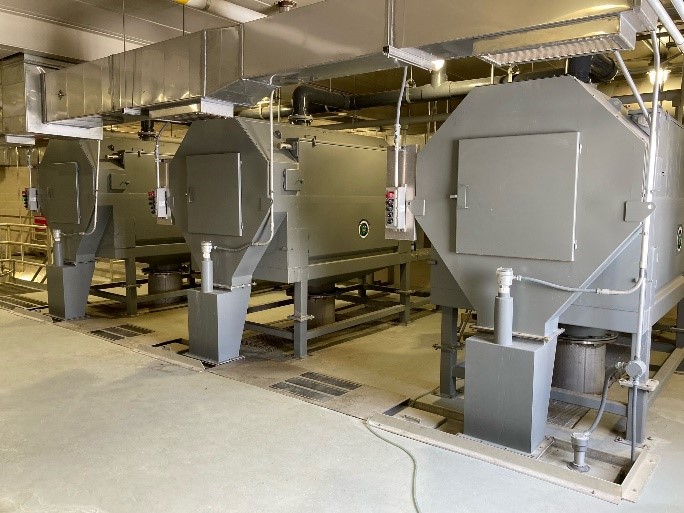
Wastewater collected from the city is pumped to screening and grit removal systems to remove plastics, rags, sand, and other larger objects in the raw wastewater that could damage the process equipment. In 2022, a major reconstruction project of the preliminary treatment (headworks) building took place that changed the process in which the facility received, screened, and distributed the wastewater from the main lift stations. The four original static screens were replaced with three large self-cleaning rotary drum screens, similar to the ones added in the MBR
project of 2008.
Now any combination of the five total drum screens can automatically be used to screen the incoming wastewater as flows increase or subside. Once screened, the wastewater goes through a new grit removal headcell to settle out inorganics like fine sand and heavy plastic particles. Only then does the partially treated wastewater get distributed by a new flow splitter box to one of the three processes: the original oxidation dites, the MBR, or the equalization basin.

Equalization Basin (EQ)
During periods that exceed the maximum wet weather flow design of 9.62 MGD, the excess influent can be diverted to the flow equalization basin. Lined with high-density polyethylene plastic, this basin serves as a temporary storage reservoir for as much as two million gallons of wastewater. After a storm has passed, the wastewater can then be drawn from the basin for treatment as plant capacity becomes available. Enhancements of larger pumps and new piping made during the headworks project in 2022 now give the treatment facility the capacity to reroute any incoming flow around preliminary treatment and into the oxidation ditches for full treatment capabilities.
Biological Treatment
Oxygen is added to the wastewater in the two-oxidation ditches to help microorganisms consume organic wastes. There are two extended aeration units (each 377 feet long, 67 feet wide, and 12 feet deep) each containing 2.16 million gallons of wastewater. Until recently, these were the largest municipal oxidation ditches of this type in the Midwest. Each was equipped with six rotating surface aerators and two aerating mixer units to mix the wastewater with the microbiology and to induce oxygen into the mixture. A project in 2018 placed the four aerating mixer units in place of four of the rotors in one of the ditches to incorporated the separation of aeration and mixing as a means of introducing biological nutrient removal (BNR) to the treatment process. BNR is a chemical free means of removing the nutrients of phosphorous and nitrogen, commonly found in municipal wastewater but not desired in receiving waters. Phase 2 of this project is replacement of the final two rotors with larger aerating mixer units, completing the transformation of that ditch in 2023. A more concentrate microbe/wastewater mixture is aerated into two separate aeration tanks before being transferred into the membrane tanks of the MBR process. Once int he membrane tanks, the water is continuously aerated to achieve optimum mixing and to reduce fouling of the membranes. A chemical process for phosphorus removal ensures that the plant can remove greater the 90 percent phosphorus that was previously discharged to the river. Trials of manipulating how the air is distributed in the aeration basins are underway in attempts to enact the BNR process to this treatment system.
Disinfection
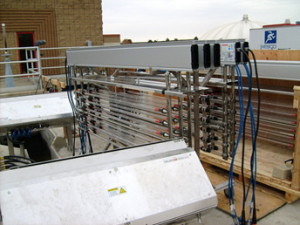
Before discharging the water to the South Fork of the Crow River, it is sent through an ultraviolet (UV) disinfection system where UV light is used to eliminate any remaining bacteria.
To reduce the safety and security concerns associated with gaseous chlorine, the old chlorine disinfection system was removed and replaced with UV disinfection in 2008. The water that is filtered through the membrane strands of the MBR is so clean that it needs no additional UV disinfection before being discharged to the receiving stream, thus it bypasses this treatment and is safe enough for reuse purposes as non-potable service water throughout the facility.
Bio-Solids Handling and Dryer Facility
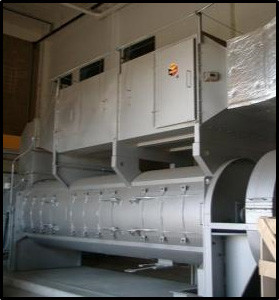
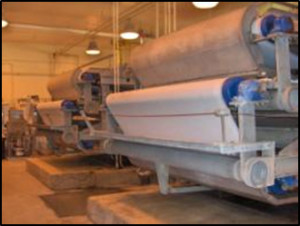
The biological process of treating wastewater uses microbiologic organisms to consume the waste and nutrients in the water. As these organisms consume materials in the wastewater, they exude energy by multiplying, or simply dividing, as is the case with the single celled bacteria. Excess activated sludge separated from the wastewater during the treatment process is pumped to one of two storage tanks for eventual dewatering volatile solids reduction and eventual further dewatering. The two large sludge presses are used to take the liquid waste at 2% solids content and obtain a sludge cake of 18-20% suitable for fertilizing farmlands as a means of disposal. The City reserves approximately 700 acres of farm land for the application of biosolids.
The Bio-Solids Dryer Facility is another City initiative to improve efficiency while serving the growing needs of Hutchinson residents and businesses. The goal of the facility is to enhance bio-solids processing and provide the community with a “Class A” bio-solids to meet stringent federal standards and reduce disposal costs. Future additions to the facility could possibly improve the end product from a soils enhancing material to a marketable fertilizer for residential, commercial and agricultural use.
Planning for the Future
Significant measures have taken place to ensure the viability and performance of the 35-year-old treatment facility for now and long into the future. In 2016, a study was performed with the mission to review the eleven remote lift stations throughout the community and create a plan to rehabilitate and standardize the process equipment, while upgrading the electronic control panels to a more consistent and widely used brand of hardware. Each year since that time, one f the lift stations has received new pumps, piping, access hatch and control panel. This effort provides peace of mind for customers of the surrounding area against the change of station failure and sanitary sewer backups.
An extensive facility assessment conducted in 2017 researched the future useful life of all plant and process equipment. This study estimated when each piece of equipment would need attention for repair or replacement, as well as a future capital cost for each. A Capital Improvement (Needs) Plan (CIP) was formulated that forecasted out over the next 20 years. This long-range CIP is used in creating the more certain 5-year CIP which is used to guide the planning of projects for the rehabilitation and optimization of the treatment plant and processes that will require substantial capital to complete. Projects such as the East Ditch Optimization, Preliminary treatment Improvements, and Solids Handling Improvements are fruits of the labors put worth in carefully stringent planning with always an eye on the future.
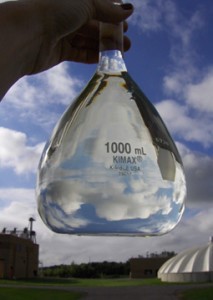
Final Effluent from MBR – Suitable for reuse as treatment plant process water.