City of Hutchinson’s Forestry Division
The City of Hutchinson’s Forestry Division has a long tradition of supporting a robust community forest which currently consists of over 13,000 public trees.
Hutchinson has been a Tree City USA program for over 40 years. We take great pride in our “forest on the prairie” and strive to improve and expand it through maintenance and planting activities thereby ensuring the benefits of a healthy urban forest for generations to come.
Forestry operations are provided through the combined efforts of the Public Works and Parks Departments who prune, remove and plant trees while also providing educational outreach to local schools and civic groups.
Hannah Kruger
Arborist
HATS
1400 Adams St SE
Hutchinson, MN 55350
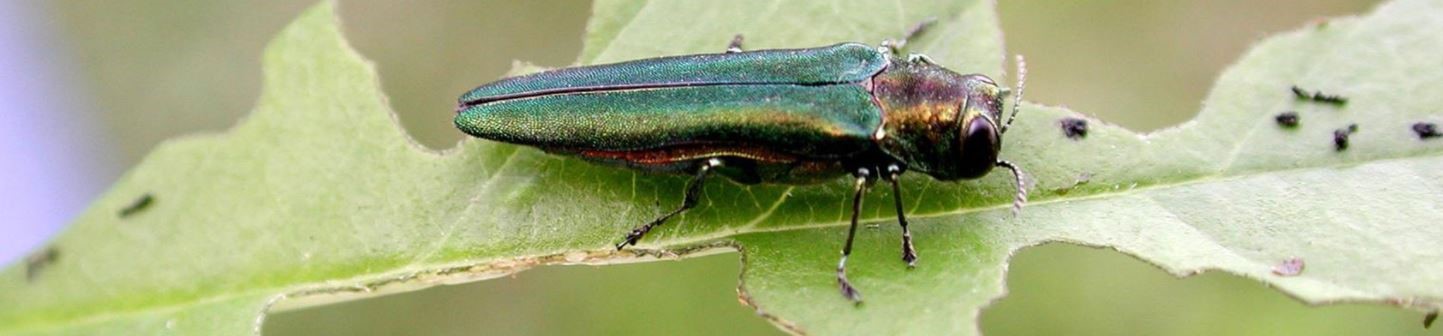
Emerald Ash Borer

Emerald Ash Borer (EAB) was discovered in August of 2023 in McLeod County, just east of Hutchinson at the intersection of County Road 4 and Highway 7. With the advent of EAB this close to our community, it’s time to start increasing awareness about how this will impact our community and provide informational resources for residents. We could see the impact of this issue as early as summer of 2024, based on the extent of the damage on the tree where the insect was discovered and its proximity to Hutchinson. While this will be a significant impact on the city in terms of publicly owned trees, it will be even more difficult for residents with ash trees on private property. We have enacted ordinance language that will allow us to issue removal or treatment orders for trees that are clearly infested with EAB on private property. Unlike Dutch Elm Disease where removal orders were issued for sanitation to slow the spread of the disease, the removal or treatment orders for ash will be issued primarlity for resident safety, public safety, and reducing private property damage. Ash trees infested with EAB can decline and fail much more rapidly than other trees after they die, thereby creating a hazard if not removed promptly. Removal orders will contain details about when the tree should be removed, where the wood and brush should go, and what to do if a resident wishes to have the city contract the removal and have the cost added to their property tax. There is a list of online resources below, that will address many of the questions we have received about EAB. For any further questions, please use the Ask a Question Form on the bottom of this webpage.
EAB Location Map
View the Emerald Ash Borer Status website.
Minnesota Department of Agriculture
This will be our main resource on all things EAB. It has information about how to identify EAB, treatment options, how to find a removal contractor, and just about everything useful that the department of agriculture has accrued since the advent of EAB.
View the Emerald Ash Borer Minnesota Department of Agriculture website.
Treatment Option for EAB
This link gives details on evaluating if you should treat your tree or opt for removal: Is My Ash Tree Worth Treating for Emerald Ash Borer? – Wisconsin Horticulture website
This link is a comprehensive list of insecticides and how to use them, both for the homeowner and the certified pesticide applicator:
Urban Forestry News

March, 2020. The City of Hutchinson was recently awarded a tree planting grant through the Minnesota Department of Natural Resources. The grant is being funded by the Environment and Natural Resources Trust Fund. Grants were awarded to several cities in Minnesota to help mitigate the impact of Emerald Ash Borer.
This funding will allow the City to plant about 275 trees over the next two planting seasons. Trees of other species purchased with grant money will be replacing ash trees that have already been removed or those selected for removal in the very near future.
City crews have accelerated efforts to remove low quality ash trees. Selected ash trees in areas with high numbers of ash trees have also been targeted for removal. Under this grant, City planting efforts will be focused in parks and other public areas. Some of the trees will also be planted as boulevard replacements.
Tree Pruning
Pruning is considered a preventative maintenance technique in the field of horticulture. Pruning can be done to remove dead, dying or diseased branches, or to remove branches that obscure vision at intersections. Pruning is especially important on young trees to ensure proper structure and growth into maturity.
The City of Hutchinson is responsible for pruning boulevard trees. If you would like to request your boulevard tree to be pruned, please call Forestry at (320) 234-4459. The “Ask a Question” form, at the bottom of this page, is also available for your use. If you have questions about pruning your private tree, find out more information at the University of Minnesota Extension website.
Storms & Tree Damage
Almost every year, storms and winds damage trees. In certain situations, city staff will declare a STORM event. This is declared when a weather event generates more tree debris than residents can reasonably expect to remove on their own or through contracted means. City staff will evaluate the amount of damage immediately following an event and determine whether a STORM will be declared. Staff will utilize criteria such as:
- Wind speed severity and direction (east and northeast winds generally cause more damage than south and west winds)
- Amount of large tree debris on the ground (events that generate large amounts of tree debris on a high percentage of properties will generate a STORM declaration)
- Intensity in a given area (some wind events are extremely localized but result in catastrophic damage, a small area of severe damage would generate a STORM declaration)
Following a storm qualifying event, the City Public Works department will declare the event a STORM by posting notice on the City’s website and social media outlets. The decision to declare a STORM is not made without due consideration. When a STORM is declared this can generate up to a 3-week timeframe where all available street department resources are unavailable except for tree work. Hutchinson has 2 excellent resources in its compost bin program and the close proximity of the Creekside composting facility which residents are encouraged to take advantage of.
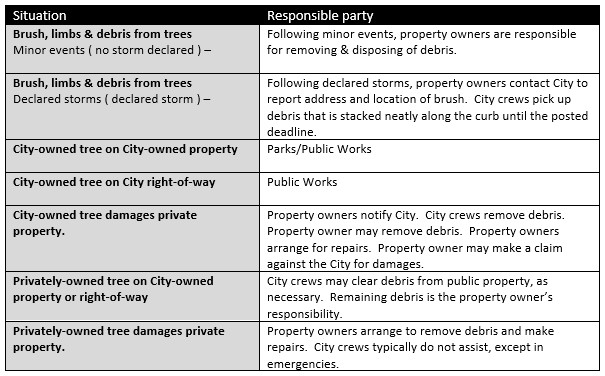
While any number of situations may arise following a storm, the usual situations are:
Storm Response
No declared storm: Property owners are responsible for cleaning up their own property and disposing of brush, limbs & debris. Brush, limbs & debris may be disposed of free of charge at Creekside Soils, 1500 Adams St SE.
Declared storm: The City provides service to property owners by picking up brush, limbs & debris. Property owners are responsible for cutting and neatly stacking brush, limbs & debris along the curb. To be eligible, property owners must submit a Report a Problem form on the city’s webpage or call Public Works at (320) 234-4219 to identify their address and provide a description where the brush, limbs & debris are located.
The notice will identify a deadline, usually 7-10 days following the storm. After the deadline, property owners are responsible for cleaning up their own property and disposing of brush, limbs & debris.
City crews are not responsible for cleaning up complete private tree removals nor for picking up any brush, limbs & debris that are clearly unrelated to the storm event.
Severe storms & disasters: Severe storm and disaster response typically involves several city crews working throughout the City over a number of days. Priority is given to clearing public roadways, then to potentially hazardous tree conditions and finally to brush, limbs & debris cleanup. Crews will use a variety of heavy equipment to efficiently remove tree debris. City crews may hold off picking up brush, limbs & debris for a time. This is done so operations can be orderly and efficient while clearing the storm’s path, specific neighborhoods, or proceeding street by street.
Damage to Private Property
City-owned tree damages private property: The property owner must notify the City as soon as possible. As soon as it is practicable, considering other priorities, City crews will be dispatched to remove the brush, limbs & debris. Property owners may utilize their own tree removal crews at their discretion and expense. Property owners must arrange for and make repairs to their private property. Property owners should contact their homeowner’s insurance company. Property owners may make a claim against the City for damages by providing written documentation to the City of Hutchinson Finance Department. Claims must include name, address, dates of when damage occurred and when notification was provided to the City, damage descriptions and repair costs.
Privately-owned trees on City right-of-way or property: City crews will typically remove brush, limbs & debris up to or near enough to property lines to ensure safe passage for traffic and safe use of rights-of-way. Property owners are responsible for removing the remainder.
Privately-owned tree damages private property: Property owners should make their own arrangements to remove brush, limbs & debris and to arrange for any necessary repairs. Because city crews are busy addressing damage to and from publicly-owned trees, they are typically not available to provide services involving private trees on private property. However, the City may provide limited services to private property under emergency situations. For example, forestry crews may assist other emergency responders gain necessary access to private property.
Boulevard Tree Planting
The City plants boulevard trees each year in Hutchinson. When a tree is removed on the boulevard, we will plant a tree the following year to replace the tree removed. If you have an area on the boulevard that is appropriate for a new planting, please call Forestry at (320) 234-4459.
New Home Tree Planting
When a new home is constructed in Hutchinson, two new trees are planted by the City in the boulevard. New construction trees are generally planted in the fall on all properties that were completed that year. Trees will only be planted if the turf/sod has been installed. On properties that can only fit one tree, the second may be planted elsewhere in the development.
Planting a New Tree
There are several aspects to consider when planting a new tree, i.e.) proper planting depth and width, removal of encircling/girdling roots, mulching, watering, etc. It is very important to keep in mind these techniques to ensure the health and vitality of your newly-planted tree or shrub.
For proper planting techniques, take a look at these simple steps
Wondering what to plant? Updated 2/22/2018
Why are some species not recommended for planting? The City of Hutchinson has chosen not to recommend certain tree species for planting because of their susceptibility to particular insects or diseases. For instance, the City is currently recommending that homeowners do not plant ash species because of the potential threat of emerald ash borer – a non-native, invasive insect that kills only ash trees. Another example would be the recommendation to not plant bur oak since bur oak blight – a leaf blight disease – is currently present in Hutchinson. So before planting a species that is not on the Recommended List, we advise that you do a little research on your tree of choice
Benefits of Urban Trees
Trees planted within a city provide many benefits, including economic, environmental and social benefits. Utilizing a free software suite – i-Tree – from the USDA Forest Service, Green Corps member, Kirstin Taggart, calculated the benefits that Hutchinson’s street trees provide. The following infographic details these benefits,
Tree Disease and Infestation Concerns
EAB (Emerald Ash Borer)
Starting in 2014, the City of Hutchinson will be implementing a forestry management plan in response to the threat of emerald ash borer. The plan, better known as the Forestry Diversification Project, consists of several small tree removal and replacement projects that will occur on an annual basis, increasing tree species diversity to reduce the risk of loss to our ash tree population. Here is a general project overview:
- Projects will target ash trees in the publicly-owned right-of-way;
- Priority project areas – areas in which a project will occur – have ash populations above 20% and are areas of high visibility, i.e.) parks, main thoroughfares, playgrounds, etc.;
- All publicly-owned, ROW ash trees have been identified and inventoried. Project areas that are found to have more than 20% ash will have a certain percentage of ash trees removed and replaced with an alternative species known to do well in Hutchinson. Trees found to be in poor condition will be prioritized for removal;
- Projects will occur on an annual basis until the desired ash population has been reached, or until emerald ash borer arrives in Hutchinson, whichever comes first.
If you have questions or are wondering whether or not this project will take place in your area, please contact Forestry at (320) 234-4459 or use the “Ask a Question” form below.
To learn more about the symptoms, signs and current status of emerald ash borer, visit the MN Dept. of Agriculture.
Dutch Elm Disease
Here are a few ways to ensure that your elms or your neighbor’s elms have a better chance of surviving:
- Any elm firewood with bark intact is dangerous to other elms. Debark or burn the firewood by April 1st.
- Notify the City Natural Resource Specialist of yellow leaves in the upper crown of elm trees, especially in mid-June and July.
- Notify the City Natural Resource Specialist of any elms that do not leaf out by May 20th.
Every set of eyes looking for diseased elms is a great help. Mature trees are a valuable asset. Keeping them as long as we can is nothing more than common sense.
Bur Oak Blight
In 2010, Bur Oak Blight, better known as BOB, was discovered in Hutchinson. BOB is a leaf blight disease that occurs only in bur oaks and has been reported in several Midwestern States since the 1990s.
For more information on symptoms and management, visit the University of Minnesota – My Minnesota Woods.
an exploration of two macro-infusion treatments
Have a tree health issue not listed here?
Resources
University of Minnesota Extension
Research-based information for landowners, loggers and industry professionals to help protect and improve Minnesota’s woodlands.
University of Minnesota – My Minnesota Woods
U of M Forest Resources Extension – home to all of the MN tree-related information you may need as a homeowner or industry professional.
Minnesota Department of Natural Resources – Division of Forestry
Learn more about what’s going on in the field of forestry here in MN. Topics include fire management, state land management, education and assistance, and more!
View all Insect Pests & Diseases
All of the information you need to know about tree pests and diseases in MN You can also find out more information about the emerald ash borer quarantine.
International Society of Arboriculture – Trees Are Good!
Resources on how to properly care for urban trees and what benefits these trees are providing. Reliable tree care information is provided by the International Society of Arboriculture and other industry organizations.
Ask a Question or Request for Tree Work or Inspection
We would like to hear from you!